
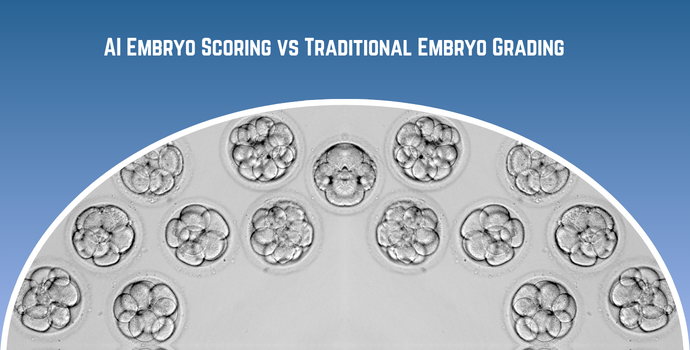
AI embryo scoring and traditional embryo grading both aim to identify the embryo most likely to result in a pregnancy, but they arrive at that answer differently. Traditional grading relies on an embryologist visually scoring cell number, symmetry and fragmentation under a microscope at set checkpoints, typically day 3 and day 5. AI scoring analyses continuous time-lapse images of the embryo’s entire development and outputs a numerical viability score, catching growth patterns a single microscope snapshot can miss.
According to Dr. Hrishikesh Pai, best IVF specialist in India, “AI doesn’t replace the embryologist’s eye, it gives that eye thousands of extra data points the microscope alone never captured.”
How Is Traditional Embryo Grading Done?
Traditional grading happens at two fixed checkpoints and depends on what’s visible under the microscope at that exact moment.
Day 3 Check: Embryologists count cells and rate fragmentation, with 6 to 10 cells and minimal fragmentation considered the strongest sign of healthy division.
Day 5 Check: Blastocysts get an expansion number from 1 to 6 plus two letters for inner cell mass and trophectoderm quality, so a top result reads something like 5AA.
Subjectivity: Two embryologists can grade the same embryo slightly differently, since the system depends on trained visual judgment rather than a fixed measurement.
Snapshot Limit: Grading only captures how the embryo looks at that one checkpoint, so a slow start or brief irregularity between checkpoints goes unrecorded.
Continuous imaging through an embryoscope is what actually makes AI scoring possible, since it captures the embryo at every stage rather than just two.
How Does AI Scoring Change the Selection Process?
AI scoring adds a second, data-driven layer on top of traditional grading rather than replacing it outright.
Continuous Data: The AI reviews thousands of time-lapse images across the full culture period, not just the two checkpoints a grading system relies on.
Viability Score: Bloom IVF’s AI system outputs a score from 0.0 to 10.0, with scores closer to 10.0 reflecting the highest confidence of clinical pregnancy.
Reduced Subjectivity: Because the scoring model applies the same criteria to every embryo, it removes some of the observer-to-observer variation seen in manual grading.
Works With Grading: The AI score gets read alongside conventional grading and blastocyst quality, not used as a standalone replacement for it.
A high AI score still gets weighed against everything covered in What Is Embryo Grading in IVF?, since the two methods work best read together.
Why choose Dr. Hrishikesh Pai?
Dr. Hrishikesh Pai is MD, FRCOG (UK-Hon), MSc, FCPS and FICOG, with over 40 years of experience in obstetrics, gynecology and infertility. He’s the Founder and Director of the Bloom IVF Group, which has crossed 25,000 IVF cycles across eight centres and now runs Life Whisperer AI embryo scoring alongside conventional grading in every lab.
Patients sometimes assume a lower traditional grade rules an embryo out, and that’s not always true once the AI score and time-lapse history get factored in. The embryo that gets transferred is the one the full picture supports, not just the label on a single microscope image.
Not sure whether your embryo’s grade tells the whole story?
Frequently Asked Questions
Does AI scoring replace traditional embryo grading?
No, it’s used alongside grading, not as a replacement for it.
Can an embryo with a lower grade still have a high AI score?
Yes, since AI evaluates development patterns grading alone can’t capture.
Is AI embryo scoring available for frozen embryo transfer too?
Yes, AI scoring applies to embryos before freezing or fresh transfer.
Does subclinical hypothyroidism need treatment before IVF?
Most fertility protocols treat it once TSH crosses 2.5 mIU/L.