
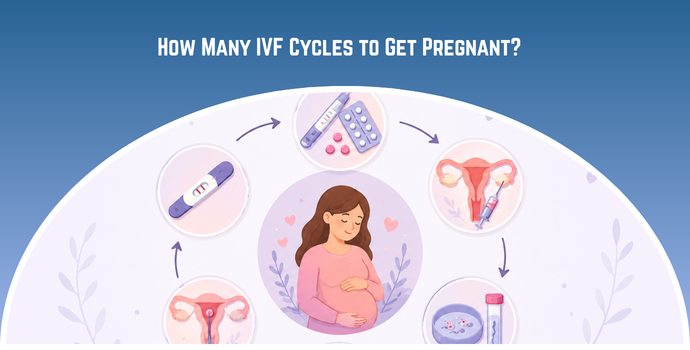
There is no fixed number. Some women conceive on the first attempt. Most need two to three cycles. Fertility specialists generally recommend planning for three to four, because the cumulative chance of success increases meaningfully with each round. Published data from large registries shows that by the third cycle, more than half of women under 40 will have achieved a live birth. After 40, the numbers are lower and the conversation changes.
According to Dr. Hrishikesh Pai, one of the leading IVF Doctor in Delhi, “One failed cycle does not define your chances. IVF is cumulative. Each cycle teaches us something, and each protocol adjustment gets us closer. I tell patients to think in terms of a journey, not a single attempt.”
What do the numbers look like cycle by cycle?
These figures are drawn from large population-based studies tracking thousands of women through multiple complete IVF cycles. A complete cycle includes the fresh transfer and any frozen embryo transfers from the same egg retrieval.
|
Cycle |
Live birth rate that cycle |
Cumulative live birth rate (under 40) |
|
1st |
30-32% |
30-32% |
|
2nd |
25-27% |
45-51% |
|
3rd |
22-24% |
55-63% |
|
4th |
18-20% |
60-68% |
|
5th-6th |
15-18% |
65-72% |
The per-cycle rate dips slightly with each attempt, but the cumulative number keeps climbing. That is the figure that matters. A woman under 40 who commits to three cycles has a better than even chance of taking a baby home. After six cycles, the cumulative rate approaches 70%. For women aged 40 to 42, the first-cycle rate drops to around 12%, and cumulative rates after three cycles sit closer to 25-30%. Over 42, per-cycle rates fall below 4%, and additional cycles offer diminishing returns. The full process of what each cycle involves is explained on the IVF treatment page.
What affects how many cycles you will need?
Every patient is different. These are the main factors that determine whether it takes one cycle or five.
Age at the time of treatment The single biggest predictor. Under 35, per-cycle rates are highest and most women need fewer attempts. After 38, the decline accelerates and the number of cycles required to reach the same cumulative odds goes up.
Embryo quality Cycles that produce chromosomally normal embryos have implantation rates of 60 to 70%. Without PGT-A testing, the odds are lower and more cycles may be needed to find the right embryo.
The underlying diagnosis Tubal factor, male factor, endometriosis, unexplained, each responds differently. Some diagnoses have straightforward solutions in the first cycle. Others need protocol refinement across multiple attempts.
Protocol adjustments between cycles A doctor who changes the stimulation drug, the dose, the trigger timing, or the transfer strategy between cycles is extracting information from each failure. Repeating the same protocol after a failed cycle is rarely productive.
The laboratory Lab quality varies. Culture conditions, incubator technology, the experience of the embryology team, all of these influence how many eggs become usable embryos and how many cycles that takes.
When cycles keep failing and the reasons are not obvious, a structured workup for recurrent failure is the next step. That is discussed in the guide on recurring failure.
Why choose Dr. Hrishikesh Pai?
Dr. Hrishikesh Pai has been practising reproductive medicine for over 40 years now. MD, FRCOG (UK-HON), MSc (USA), FCPS, FICOG. He set up the Bloom IVF Group from scratch and the number has crossed 25,000 ivf cycles at this point, across eight centres. Lilavati Hospital in Mumbai, DY Patil in Navi Mumbai, three Fortis locations in Delhi, Gurgaon and Mohali. The labs have moved to Life Whisperer AI for embryo grading because relying purely on visual assessment under the microscope has its limits.
He does not run the same protocol twice without a reason. Each cycle is reviewed, adjusted and planned around what the previous one revealed.
Book a Consultation with Dr. Hrishikesh Pai to understand how many IVF cycles you may need to get pregnant and to receive a personalized treatment plan tailored to your fertility goals.
Frequently Asked Questions
What is the average number of IVF cycles to get pregnant?
Most women conceive within two to three complete cycles. Some on the first. Planning for three to four gives the most realistic picture of cumulative odds.
Do success rates drop with each cycle?
Per-cycle rates dip slightly, but the cumulative chance keeps rising. That cumulative number is what matters when planning.
Should I keep trying after three failed cycles?
It depends on age and diagnosis. Under 40, additional cycles still add meaningful odds. Over 42, the returns diminish and alternative approaches like donor eggs may need to be discussed.
Does switching clinics help after failed IVF?
Sometimes. A different lab, a different protocol philosophy, or a fresh set of eyes on the case can make a difference. It is worth considering if the current approach has stopped producing new information.
References
- Cumulative live birth rates after one or more complete cycles of IVF: a population-based study of 178,898 women – National Library of Medicine (PMC)
- Cumulative live-birth rates by maternal age after one or multiple in vitro fertilization cycles – National Library of Medicine (PMC)