
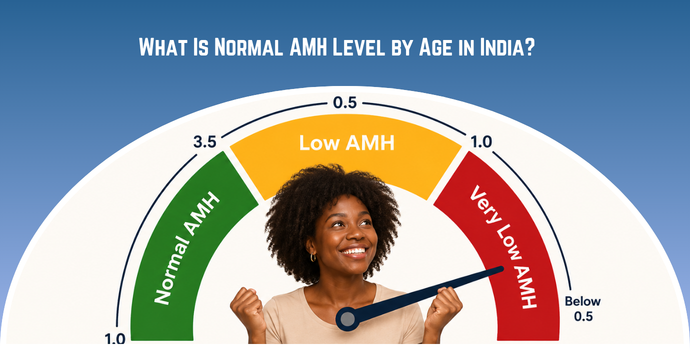
Normal AMH levels sit between 2.0 and 6.0 ng/mL through your 20s, then fall from there. The number tracks egg quantity, not quality, and it’s highly individual. What Indian studies keep flagging is something most patients don’t expect: more than half the women testing low for ovarian reserve are under 35. Generic Western reference ranges don’t capture that. Age-specific Indian data does.
According to Dr. Hrishikesh Pai, a leading IVF Doctor in India, “AMH tells you how much time you have, not whether you can conceive. A low number at 28 is a call to plan. It is not a verdict.”
What Do Normal AMH Levels Look Like Across Age Groups in India?
A retrospective study covering over 5,500 infertile women mapped Indian-specific medians by age bracket. The numbers drop faster than most patients are told to expect.
|
Age Group |
Median AMH (Indian Data) |
Clinical Reading |
|
20 to 25 years |
4.23 ng/mL |
Good ovarian reserve |
|
26 to 30 years |
3.48 ng/mL |
Normal, slight natural decline |
|
31 to 35 years |
2.43 ng/mL |
Acceptable, worth monitoring |
|
36 to 40 years |
1.28 ng/mL |
Low to borderline |
|
40 to 44 years |
0.52 ng/mL |
Low reserve, needs prompt assessment |
Regional variation matters too. A North vs South India study found women aged 22 to 30 averaged 4.4 ng/mL in the North and just 2.04 ng/mL in the South. Running your result against a single national cutoff misses that gap entirely.
The low reserve threshold most clinics work with is 1.1 ng/mL. Indian data puts 14.5% of women under 35 already below it. At the other end, anything above 6.0 ng/mL in a younger patient needs a PCOS screen, not reassurance.
AMH stays stable across the menstrual cycle, so there’s no specific day you need to test. Women thinking about delaying pregnancy should get tested early — it leaves real lead time to consider egg freezing before reserve falls further.
What Does a Low AMH Result Actually Mean for Fertility?
Low AMH is about quantity. Nothing else. Women with levels under 1.0 ng/mL get pregnant naturally and through IVF regularly. The number shifts the plan, it doesn’t close the door.
Early decline is common in India Close to 29% of women under 30 visiting fertility centres already showed AMH at or below 2.0 ng/mL. By the early 30s, nearly half did. Researchers point to endocrine-disrupting chemicals, diet, genetics and stress as likely contributors.
The phrase “early ovarian senescence” is appearing in Indian research It describes a pattern of reserve loss happening younger than expected, and it’s specific enough to the Indian population that Western benchmarks don’t fully account for it.
A low result changes the IVF protocol, not the possibility AMH of 0.8 ng/mL at 31 carries a different urgency than the same reading at 38. Stimulation is adjusted, timing is discussed earlier, and antral follicle count is always checked alongside it.
AFC and AMH together are more informative than either alone The ultrasound count and the blood test together give the clinic a fuller picture before any protocol is set.
An AMH result below 1.1 ng/mL should prompt a detailed fertility assessment, not just a repeat test. What matters next is not the number itself but what the clinic does with it. For women exploring what the AMH test involves and how results are interpreted, the guide on AMH test and fertility covers what the number means in a clinical context.
Why choose Dr. Hrishikesh Pai?
Dr. Hrishikesh Pai has been a fertility specialist for over 40 years. MD, FRCOG (UK-HON), MSc (USA), FCPS, FICOG. He built the Bloom IVF Group from the ground up, now past 25,000 cycles across eight centres in Mumbai, Navi Mumbai, Delhi, Gurgaon and Mohali. The labs run Life Whisperer AI for embryo grading because manual assessment alone has limits.
Low AMH doesn’t automatically change the outcome. What changes is the protocol. No cycle at Bloom IVF gets designed around a single number. AMH, AFC, age and prior response together shape the stimulation approach, and that decision is made before the first injection is prescribed.
Book a Consultation with Dr. Hrishikesh Pai to understand what a normal AMH level is for your age and how to optimize your fertility potential for a successful pregnancy.
Frequently Asked Questions
What is a normal AMH level for a 30-year-old Indian woman?
Indian data puts the median at roughly 3.48 ng/mL for women aged 26 to 30. Above 1.1 ng/mL in this bracket is generally within an acceptable range.
Can AMH levels improve?
No. AMH reflects remaining egg count and doesn’t go up over time. Lifestyle changes can support how well those eggs mature, but they don’t rebuild the reserve.
Does a low AMH mean IVF will not work?
Not necessarily. Women with low AMH do succeed in IVF. The stimulation protocol gets adjusted to work with the follicles available rather than pushing for a bigger response.
Should AMH be tested at a specific time in the cycle?
No specific day needed. Unlike FSH, AMH stays stable across the cycle, so it can be drawn at any point.
References
- Age-Specific Distribution of Serum Anti-Mullerian Hormone and Antral Follicle Count in Indian Infertile Women – National Library of Medicine (PubMed)
Geographical Diversity in Age Specific Anti Mullerian Hormone Levels in Infertile Women: A Hospital Based Cohort Study – PMC, National Library of Medicine